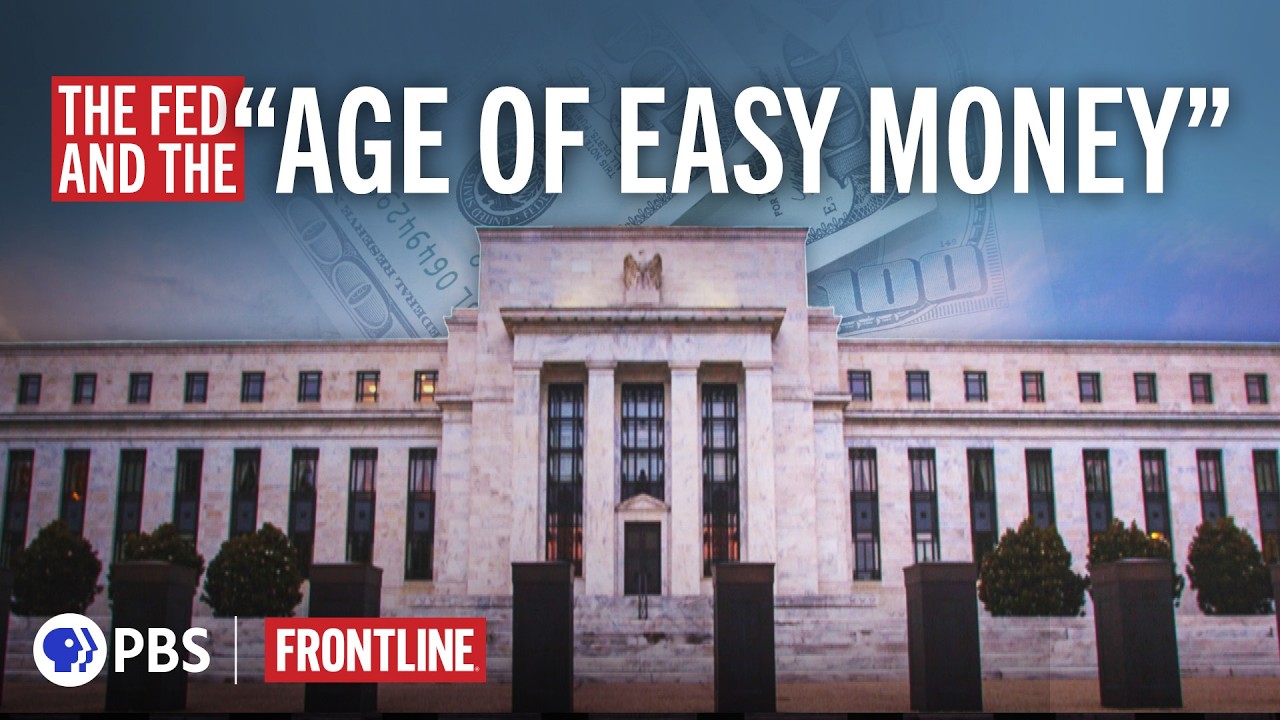
Source: Age of Easy Money (full documentary) | FRONTLINE — FRONTLINE PBS | Official · 1:53:18 · published 2023-03-15
TL;DR
The documentary explores how the Federal Reserve’s easy money policies, including quantitative easing and low interest rates, have shaped the economy. It argues that while these measures provided short-term relief, they may lead to long-term challenges like inflation and potential unemployment spikes. The film questions whether central banks should be the primary drivers of economic growth.
Chapter map
0:28-1:41 Economic Policies and Central Bank Role (definition)
The narrative explores the role of the Federal Reserve in managing the economy, including its policies of easy money and quantitative easing. It highlights the impact of these policies on financial systems and economic growth.
1:41-4:56 Jackson Hole Summit and Monetary Policy Decisions (reasoning)
The Federal Reserve’s decisions at the Jackson Hole summit are analyzed, focusing on the challenges of controlling inflation and the potential for economic recession. The Fed’s communication and policy direction are discussed.
4:56-12:25 Quantitative Easing and Its Consequences (example)
The implementation of quantitative easing during the 2008 financial crisis is examined, including its intended effects on the economy and the unintended consequences, such as increased wealth inequality and market dependency on Fed actions.
12:25-21:30 Long-Term Effects of Easy Money Policies (reasoning)
The long-term implications of the Fed’s easy money policies are explored, including the stock market’s reliance on central bank support, the rise of economic inequality, and the challenges of reversing these policies without causing instability.
21:30-30:06 Political and Economic Repercussions (reasoning)
The political and economic repercussions of the Fed’s policies are discussed, including the rise of movements like the Tea Party, the impact on democratic institutions, and the ongoing debates about the role of central banks in economic management.
29:06-31:33 Economic Inequality and Fed Policies (example)
The transcript discusses how the Federal Reserve’s policies, particularly quantitative easing, have exacerbated economic inequality by benefiting the wealthy through stock market gains. Critics argue that these policies prioritize Wall Street over middle-class workers.
31:33-34:53 Fed’s Mandate and Criticisms (reasoning)
The Fed’s focus on employment and economic recovery is examined, with criticism that it overlooks the impact on lower-income Americans. The transcript highlights debates about whether the Fed should address wealth inequality directly.
34:53-43:15 Political and Economic Consequences (reasoning)
The transcript explores how the Fed’s policies contributed to growing wealth gaps and political unrest, influencing populist movements like Trump’s campaign. It also covers the role of corporate buybacks and debt in shaping the economy.
43:15-53:35 Shadow Banking and Systemic Risks (definition)
The transcript addresses the risks posed by unregulated shadow banking systems, which became increasingly important in the financial landscape. These systems were seen as a source of instability and potential future crises.
53:35-57:44 Pandemic and Fed Response (example)
The transcript details the Fed’s response to the coronavirus pandemic, including the use of quantitative easing and emergency measures to stabilize financial markets and support the economy during the crisis.
57:44-59:06 Ongoing Challenges and Lessons Learned (conclusion)
The transcript concludes with reflections on the long-term impacts of the Fed’s policies, the challenges faced during the pandemic, and the ongoing need for regulatory oversight to prevent future economic instability.
58:06-59:13 Economic Impact of the Pandemic (definition)
The transcript discusses the significant economic impact of the pandemic, including rising unemployment and the unprecedented government response. It highlights the scale of the crisis and the measures taken to stabilize the economy.
59:15-1:00:10 The Largest Economic Stimulus Ever (example)
The Trump administration and Congress passed the $2.2 trillion CARES Act, which provided direct support to individuals and small businesses. The Federal Reserve also implemented extensive measures to stabilize the financial system.
1:00:10-1:02:05 Federal Reserve’s Unprecedented Actions (example)
The Federal Reserve took extraordinary steps, including buying corporate debt and providing massive liquidity. These actions were described as a response to an unprecedented crisis, with critics raising concerns about potential risks and moral hazard.
1:02:07-1:05:06 Market Reactions and Criticisms (reasoning)
The transcript explores the market’s reaction to the Fed’s policies, highlighting the disparity between the stock market’s performance and the struggles of ordinary Americans. Critics argue that the Fed’s actions created a ‘no-lose casino’ environment.
1:05:09-1:25:30 Rising Inflation and Economic Concerns (reasoning)
The discussion shifts to concerns about inflation, with experts warning that the combination of stimulus and monetary policy could lead to long-term economic challenges. The impact on middle-class families and the risk of a shrinking middle class are highlighted.
1:25:32-1:28:06 Impact on Families and Communities (example)
The final section focuses on the real-world effects of inflation and economic policies on families, particularly those struggling to afford basic necessities. It includes personal stories and data showing increased demand for food assistance and financial help.
1:27:06-1:28:41 Rising Inflation and Economic Struggles (example)
The transcript discusses the struggles of middle-class families facing rising costs and the shrinking middle class. It highlights the impact of rent increases and the challenges people face in maintaining their living standards.
1:28:48-1:32:41 Federal Reserve’s Response to Inflation (reasoning)
The Federal Reserve acknowledges the need to address inflation and begins raising interest rates. The discussion covers the Fed’s strategy, the effects of rate hikes on the economy, and the challenges of balancing inflation control with economic stability.
1:32:44-1:37:48 Economic Consequences of Rate Hikes (reasoning)
The transcript explores the potential for higher unemployment and economic downturns due to the Fed’s rate hikes. It includes perspectives from labor leaders and discussions about the broader implications of monetary policy on the economy.
1:37:48-1:44:43 Market Volatility and Financial Instability (reasoning)
The financial markets experience significant volatility as the Fed adjusts interest rates. The transcript discusses the impact on stock and bond markets, the bursting of asset bubbles, and the risks associated with high levels of debt.
1:44:44-1:49:49 Debt Crises and Economic Reckoning (reasoning)
The transcript addresses concerns about a potential debt crisis, highlighting the risks of excessive borrowing and the need for economic balance. It includes expert opinions on the current state of the economy and the importance of long-term sustainability.
1:49:56-1:52:55 Fed’s Role and Future Outlook (conclusion)
The final section examines the Fed’s role in managing the economy, the political challenges involved, and the need for a balanced approach to economic growth. It reflects on the lessons learned from the era of easy money and the path forward.
Key concepts
[[Federal Reserve]]
- Role: core_target · Importance: 0.95
- Required background: [[Monetary Policy]], [[Interest Rates]]
Expansion
The Federal Reserve, often referred to as the Fed, is the central banking system of the United States. Established in 1913, it was created to provide the nation with a safer, more flexible, and more stable monetary and financial system. The Fed’s primary functions include conducting monetary policy, regulating banks, maintaining financial system stability, and providing financial services to the U.S. government. It consists of three main components: the Board of Governors, the 12 regional Federal Reserve Banks, and the Federal Open Market Committee (FOMC). The Fed influences economic activity by adjusting interest rates and managing the money supply. During times of economic stress, it can inject liquidity into the financial system, as seen during the 2008 financial crisis and more recently with the response to the COVID-19 pandemic. The Fed’s actions have significant implications for inflation, employment, and overall economic health.
视频中: In the video, the speaker discusses how the Federal Reserve’s role in injecting money into the economy has had far-reaching effects, highlighting concerns about the broader economic implications of its policies.
Sources:
- Federal Reserve Board - About the Fed
- Federal Reserve System | Definition, History, Functions, & Facts | Britannica Money
- Federal Reserve - Wikipedia
[[Quantitative Easing]]
- Role: core_target · Importance: 0.90
- Required background: [[Federal Reserve]], [[Monetary Policy]]
Expansion
Quantitative Easing (QE) is a monetary policy tool used by central banks to stimulate economic growth when traditional methods, such as adjusting short-term interest rates, are no longer effective. It involves the purchase of large quantities of financial assets, such as government bonds or corporate securities, from commercial banks and other institutions. This process increases the money supply, lowers long-term interest rates, and encourages borrowing and investment. QE is typically employed during periods of economic crisis or when inflation is below target. While it can provide liquidity and support financial markets, it also carries risks, such as potential asset bubbles or inflationary pressures. The Federal Reserve’s use of QE during the 2008 financial crisis, as highlighted in the documentary, was a significant departure from conventional monetary policy and aimed to stabilize the economy and restore confidence.
视频中: The speaker explains that quantitative easing was an experimental way for the Fed to inject money into the financial system and lower long-term interest rates, as discussed in the context of the 2008 financial crisis.
Sources:
- Quantifying the Costs and Benefits of Quantitative Easing
- Quantitative Easing and Financial Stability
- How Quantitative Easing Works: Evidence on the Refinancing Channel
[[Jackson Hole Summit]]
- Role: supporting · Importance: 0.70
- Required background: [[Central Bank]], [[Monetary Policy]]
Expansion
The Jackson Hole Summit, also known as the Jackson Hole Economic Policy Symposium, is an annual conference hosted by the Federal Reserve Bank of Kansas City. It brings together central bankers, economists, and policymakers to discuss pressing economic issues. The event, which began in 1978, has become a key platform for influential monetary policy discussions and has historically shaped global economic expectations. Notably, it is where Federal Reserve Chair Jerome Powell has addressed topics like inflation and the role of central banks in economic growth. The summit is often seen as a significant event for financial markets, as statements and policy signals from the Fed can influence investor sentiment and economic forecasts.
视频中: In the video, the narrator mentions Federal Reserve Chairman Jerome Powell speaking at an annual economic summit in Jackson Hole, Wyoming, highlighting its importance as a key event for central bank discussions and policy announcements.
Sources:
- About the Jackson Hole Economic Policy Symposium
- Jackson Hole Economic Symposium Definition and Why Is It Important
- Jackson Hole Economic Summit Definition & Example
[[Easy Money Policies]]
- Role: core_target · Importance: 0.85
- Required background: [[Monetary Policy]], [[Interest Rates]]
Expansion
Easy money policies refer to monetary strategies implemented by central banks to stimulate economic growth by increasing the availability of money and credit. These policies typically involve lowering interest rates, reducing reserve requirements for banks, and engaging in quantitative easing to inject liquidity into the financial system. By making borrowing cheaper and more accessible, easy money policies aim to encourage investment, consumer spending, and overall economic activity. However, they can also lead to inflation, asset bubbles, and long-term financial instability if not managed carefully. The concept is often associated with expansionary monetary policy, which prioritizes short-term economic gains over long-term fiscal health. Historically, such policies have been used during economic downturns to prevent recessions or mitigate their impact.
视频中: In the video, the speaker mentions, ‘If we hadn’t been driving our economy with easy money… we wouldn’t be having these problems right now,’ highlighting how reliance on easy money policies contributed to current economic challenges.
Sources:
- EASY MONETARY POLICY definition | Cambridge English Dictionary
- EASY MONEY Definition & Meaning
- EASY-MONEY POLICY Definition & Meaning
[[Monetary Policy]]
- Role: core_target · Importance: 0.90
- Required background: [[Federal Reserve]], [[Interest Rates]]
Expansion
Monetary policy refers to the actions taken by a central bank, such as the Federal Reserve, to manage the money supply and interest rates in order to influence economic activity. The primary goals of monetary policy include promoting maximum employment, maintaining price stability, and ensuring long-term economic growth. Central banks use tools like adjusting interest rates, open market operations, and reserve requirements to achieve these objectives. For example, lowering interest rates can stimulate borrowing and investment, while raising them can help control inflation. In the context of the video, the Federal Reserve’s role in injecting money into the economy and its impact on inflation and economic growth are central themes. The documentary highlights debates over whether the Fed’s policies have shifted too much responsibility for economic growth onto central banking institutions rather than democratic processes.
视频中: The speaker discusses the Federal Reserve’s role in injecting money into the economy and how it has become the primary engine of economic growth, which is a key point in the documentary ‘Age of Easy Money.’
Sources:
- The Fed Explained - Monetary Policy
- Monetary Policy and Central Banking | IMF
- Monetary policy | Definition, Types, Examples, & Facts
[[Inflation]]
- Role: core_target · Importance: 0.80
- Required background: [[Monetary Policy]], [[Interest Rates]]
Expansion
Inflation refers to the general increase in the prices of goods and services over time, leading to a decrease in the purchasing power of money. It is typically measured using broad price indexes such as the Consumer Price Index (CPI) or the Producer Price Index (PPI). Inflation can be driven by various factors, including supply chain disruptions, increased demand, monetary policy decisions, and changes in expectations about future price levels. Central banks, like the Federal Reserve, monitor inflation closely and use tools such as interest rates to manage it. High inflation can erode savings, distort economic decisions, and lead to uncertainty. Conversely, deflation—falling prices—can also be problematic, as it may discourage spending and investment. The post-pandemic period saw significant inflationary pressures due to factors like fiscal stimulus, labor shortages, and global supply chain issues. Central banks responded with tighter monetary policies, including raising interest rates, to bring inflation under control.
视频中: The video discusses the Federal Reserve’s efforts to curb inflation, as seen in the context of Chair Powell’s speech at Jackson Hole in 2022, where the focus was on whether the Fed would continue raising interest rates to address inflationary pressures.
Sources:
- Inflation since the Pandemic: Lessons and Challenges
- The Rise and Retreat of US Inflation: An Update
- The Review and Analysis of Inflation and its Effects
[[Interest Rates]]
- Role: core_target · Importance: 0.85
- Required background: [[Monetary Policy]], [[Federal Reserve]]
Expansion
Interest rates are the cost of borrowing money, expressed as a percentage of the principal. They play a crucial role in the economy by influencing consumer spending, business investment, and inflation. Central banks, like the Federal Reserve, adjust interest rates to manage economic conditions. Lower rates make borrowing cheaper, encouraging spending and investment, while higher rates make borrowing more expensive, which can slow down economic activity and reduce inflation. Interest rates can be fixed or variable, and they affect both savers and borrowers. For example, when rates are low, savings accounts earn less interest, but loans such as mortgages or car loans become more affordable. The Federal Reserve uses short-term interest rates as its primary tool for monetary policy, adjusting them to promote stable employment and price levels. During times of economic crisis, like the 2008 financial collapse, the Fed may lower rates significantly or implement unconventional measures like quantitative easing to stabilize markets.
视频中: In the video ‘Age of Easy Money (full documentary) | FRONTLINE,’ JACOBY explains that in normal times, the Fed’s job is to promote employment and keep inflation in check primarily by raising and lowering short-term interest rates, making borrowing cheaper or more expensive.
Sources:
- How interest rates work: A beginner’s guide for borrowers and savers
- Interest and debt | Finance and capital markets
- What is the difference between a loan interest rate and the APR?
[[Central Bank]]
- Role: supporting · Importance: 0.80
- Required background: [[Federal Reserve]], [[Monetary Policy]]
Expansion
A central bank is a national institution responsible for managing a country’s currency, regulating monetary policy, and overseeing financial institutions. It plays a critical role in maintaining economic stability by controlling the money supply, setting interest rates, and acting as a lender of last resort during financial crises. Central banks also supervise banking systems to ensure they operate safely and efficiently. In addition, they manage foreign exchange reserves and provide payment system infrastructure. The Federal Reserve, the central bank of the United States, exemplifies these functions, as outlined in its official documentation. Central banks are typically independent from direct political control to ensure that monetary decisions are made based on economic conditions rather than short-term political interests.
视频中: The video discusses the Federal Reserve’s role in injecting money into the economy and the broader implications of its policies, as highlighted by Federal Reserve Chairman Jerome Powell’s remarks about the ‘age of easy money.’
Sources:
- The Fed Explained: What the Central Bank Does
- Online programme: Money and Central Banks for Beginners
- System of National Accounts 2025 — Glossary
[[Fed’s Mandate]]
- Role: supporting · Importance: 0.75
- Required background: [[Federal Reserve]], [[Monetary Policy]]
Expansion
The Federal Reserve’s mandate refers to the objectives set by Congress for the central bank to achieve through its monetary policy. The Fed operates under a ‘dual mandate’ that includes promoting maximum employment and maintaining stable prices. This means the Fed aims to support a strong labor market while preventing inflation from rising too high. In practice, this involves adjusting interest rates and managing the money supply to influence economic conditions. The Fed also has a statutory goal of achieving moderate long-term interest rates, which helps ensure economic stability over time. While the dual mandate is widely accepted, there have been debates about whether it should be reformed, such as shifting to a single focus on price stability. Recent discussions have explored new approaches, like nominal GDP level targeting, to better align the Fed’s actions with its goals. The dual mandate shapes the Fed’s decisions and has significant implications for both workers and investors.
视频中: In the video, a Fed official emphasized the Fed’s mission to put Americans back to work and boost wages, reflecting the central bank’s focus on maximum employment as part of its dual mandate.
Sources:
- What economic goals does the Federal Reserve seek to achieve through its monetary policy?
- The Fed Explained — Monetary Policy
- The Federal Reserve’s Dual Mandate
[[Economic Inequality]]
- Role: supporting · Importance: 0.70
- Required background: [[Wealth Gap]], [[Middle-Class Economics]]
Expansion
Economic inequality refers to the uneven distribution of wealth and income among individuals or groups within a society. It is often measured using indicators such as the Gini coefficient, which quantifies the degree of inequality in income or wealth distribution. High levels of economic inequality can have wide-ranging effects on social stability, political systems, and economic growth. Research suggests that excessive inequality can hinder long-term economic development by limiting access to education, healthcare, and opportunities for lower-income populations. Additionally, it can lead to increased social tensions and reduce overall economic mobility. The role of monetary policy, such as quantitative easing, has also been scrutinized for potentially exacerbating inequality, as it often benefits asset holders more than the broader population. Various studies highlight the need for targeted policies, including progressive taxation, labor market reforms, and investment in public services, to address these disparities.
视频中: In the documentary ‘Age of Easy Money,’ Joseph Stiglitz expressed concern that the Federal Reserve’s aggressive stock market stimulation through quantitative easing exacerbated economic inequality by disproportionately benefiting the wealthiest individuals who own the majority of stocks.
Sources:
- Wealth inequality and economic growth: Evidence from the US and France
- Economic Inequality and Its Socioeconomic Impact
- Unconventional monetary policy and economic inequality
[[Wealth Gap]]
- Role: supporting · Importance: 0.70
- Required background: [[Economic Inequality]], [[Middle-Class Economics]]
Expansion
Wealth gap refers to the disparity in the distribution of assets and resources among different groups within a society. It is often measured by comparing the wealth of the richest individuals or households to the poorest. In the United States, the wealth gap has been a persistent issue, with significant disparities between racial and ethnic groups. Studies show that Black and Hispanic households have significantly less wealth compared to white households, a gap rooted in historical factors such as slavery, segregation, and discriminatory policies. The Federal Reserve’s monetary policies, including low interest rates and quantitative easing, have been debated for their potential role in exacerbating wealth inequality by boosting asset prices, which primarily benefit those who already own homes, stocks, and retirement accounts. However, some argue that these policies also help lower-income workers by increasing employment and wages, improving their most valuable asset: their job. This debate highlights the complex relationship between economic policy and wealth distribution.
视频中: In the video ‘Age of Easy Money (full documentary) | FRONTLINE,’ the widening wealth gap is discussed in the context of the Fed’s focus on job creation and its potential impact on different segments of the population, particularly in relation to how policies affect both asset owners and workers.
Sources:
- Wealth Inequality in the United States since 1913: Evidence from Capitalized Income Tax Data
- Wealth of Two Nations: The U.S. Racial Wealth Gap, 1860-2020
- Seven Economic Facts About the U.S. Racial Wealth Gap
[[Middle-Class Economics]]
- Role: supporting · Importance: 0.70
- Required background: [[Economic Inequality]], [[Wealth Gap]]
Expansion
Middle-class economics refers to economic policies and frameworks that prioritize the needs and well-being of the middle class, focusing on fair opportunity, shared responsibility, and economic security. It emphasizes the importance of raising wages, improving job quality, and ensuring access to essential services like healthcare, education, and housing. This approach contrasts with trickle-down economics, which assumes that benefits for the wealthy will eventually ‘trickle down’ to the broader population. Middle-class economics is rooted in the idea that a strong middle class drives overall economic growth by boosting consumer demand and stability. The concept has been discussed in various policy contexts, including President Obama’s agenda, which aimed to support working families through measures such as wage increases, retirement security, and job creation. The theory also highlights the role of middle-class purchasing power in sustaining economic activity and reducing inequality.
视频中: The video discusses middle-class economics in the context of Federal Reserve policies and their impact on employment and wages, particularly highlighting the view that putting Americans back to work and boosting their wages directly enhances their most valuable asset—their job.
Sources:
- FACT SHEET: Middle Class Economics: Strengthening Retirement Security by Cracking Down on Backdoor Payments and Hidden Fees
- Weekly Address: Middle-Class Economics
- 2015 Economic Report of the President
[[Financial Crisis]]
- Role: supporting · Importance: 0.70
- Required background: [[Central Bank]], [[Moral Hazard]]
Expansion
A financial crisis refers to a situation where financial assets rapidly lose significant value, often leading to economic instability. These crises can manifest in various forms, such as bank runs, asset price collapses, currency devaluations, and widespread defaults. Historically, they have been linked to excessive risk-taking, speculative bubbles, and systemic failures in financial institutions. The 2007-2009 global financial crisis, for example, was triggered by the collapse of the U.S. housing market and the subsequent failure of major financial institutions. Such events typically result in reduced consumer and business confidence, credit freezes, and severe economic downturns. Governments and central banks often respond with monetary and fiscal interventions to stabilize markets and prevent further damage. Financial crises can also have long-term consequences, including changes in regulatory frameworks and shifts in economic policy.
视频中: The speaker compares the economic impact of the coronavirus pandemic to the 2008 financial crisis, noting that the U.S. government’s decision to shut down the economy was unprecedented in history.
Sources:
- Financial crisis
- The Anatomy of Financial Crises
- Financial crisis | Economics | Research Starters | EBSCO Research
Mindmap
-
Core
- Federal Reserve 0.95
- Quantitative Easing 0.90
- Monetary Policy 0.90
- Easy Money Policies 0.85
- Interest Rates 0.85
- Inflation 0.80
-
Supporting
- Central Bank 0.80
- Fed’s Mandate 0.75
- Jackson Hole Summit 0.70
- Economic Inequality 0.70
- Wealth Gap 0.70
- Middle-Class Economics 0.70
- Financial Crisis 0.70
-
Tangential
- Shadow Banking 0.60
- Joseph Stiglitz 0.60
- Aggregate Demand 0.60
- Economic Impact 0.60
- Unemployment 0.60
- Economic Stimulus 0.60
- Moral Hazard 0.60
- Stock Market 0.60
- Nobel Prize 0.50
- Trickle-Down Economics 0.50
- Neel Kashkari 0.50
- CARES Act 0.50
- Corporate Debt 0.50
- Debt Crises 0.50
- 9/11 0.40
Interactive radial view: open state/2026-05/VID-V0004/mindmap.html in a browser.
Mermaid source (for renderers that support it)
mindmap
  root((Age of Easy Money full documentary | FRONTLINE))
    Core
      Federal Reserve 0.95
      Quantitative Easing 0.90
      Monetary Policy 0.90
      Easy Money Policies 0.85
      Interest Rates 0.85
      Inflation 0.80
    Supporting
      Central Bank 0.80
      Fed's Mandate 0.75
      Jackson Hole Summit 0.70
      Economic Inequality 0.70
      Wealth Gap 0.70
      Middle-Class Economics 0.70
      Financial Crisis 0.70
    Tangential
      Shadow Banking 0.60
      Joseph Stiglitz 0.60
      Aggregate Demand 0.60
      Economic Impact 0.60
      Unemployment 0.60
      Economic Stimulus 0.60
      Moral Hazard 0.60
      Stock Market 0.60
      Nobel Prize 0.50
      Trickle-Down Economics 0.50
      Neel Kashkari 0.50
      CARES Act 0.50
      Corporate Debt 0.50
      Debt Crises 0.50
      9/11 0.40
Socratic Q&A
Q1. Why did the Federal Reserve inject money into the economy?
The Federal Reserve injected money into the economy as part of its monetary policy to stimulate economic activity and manage financial stability. (see 0:44)
Q2. What are the potential consequences of recent government stimulus programs?
Recent government stimulus programs may have contributed to economic conditions that could lead to higher unemployment in the next couple of years if not managed carefully. (see 1:12)
Q3. Why is the central bank not supposed to be the primary engine of economic growth?
The central bank is not supposed to be the primary engine of economic growth because its role is to maintain price stability and ensure financial system health, not to directly drive economic expansion. (see 0:51)
Q4. What is the significance of the Jackson Hole Summit in the context of the Fed?
The Jackson Hole Summit is considered a major event where central bankers discuss key economic and monetary policy issues, often setting the tone for global financial markets. (see 2:01)
Q5. How do higher interest rates affect inflation according to the documentary?
Higher interest rates, slower growth, and softer labor market conditions are expected to bring down inflation by reducing demand and slowing economic activity. (see 4:18)
Generated by video_analysis_os · VID-V0004 · path=B · source=qwen-turbo (Path B) · 2026-05-03T23:29:35.491233Z